
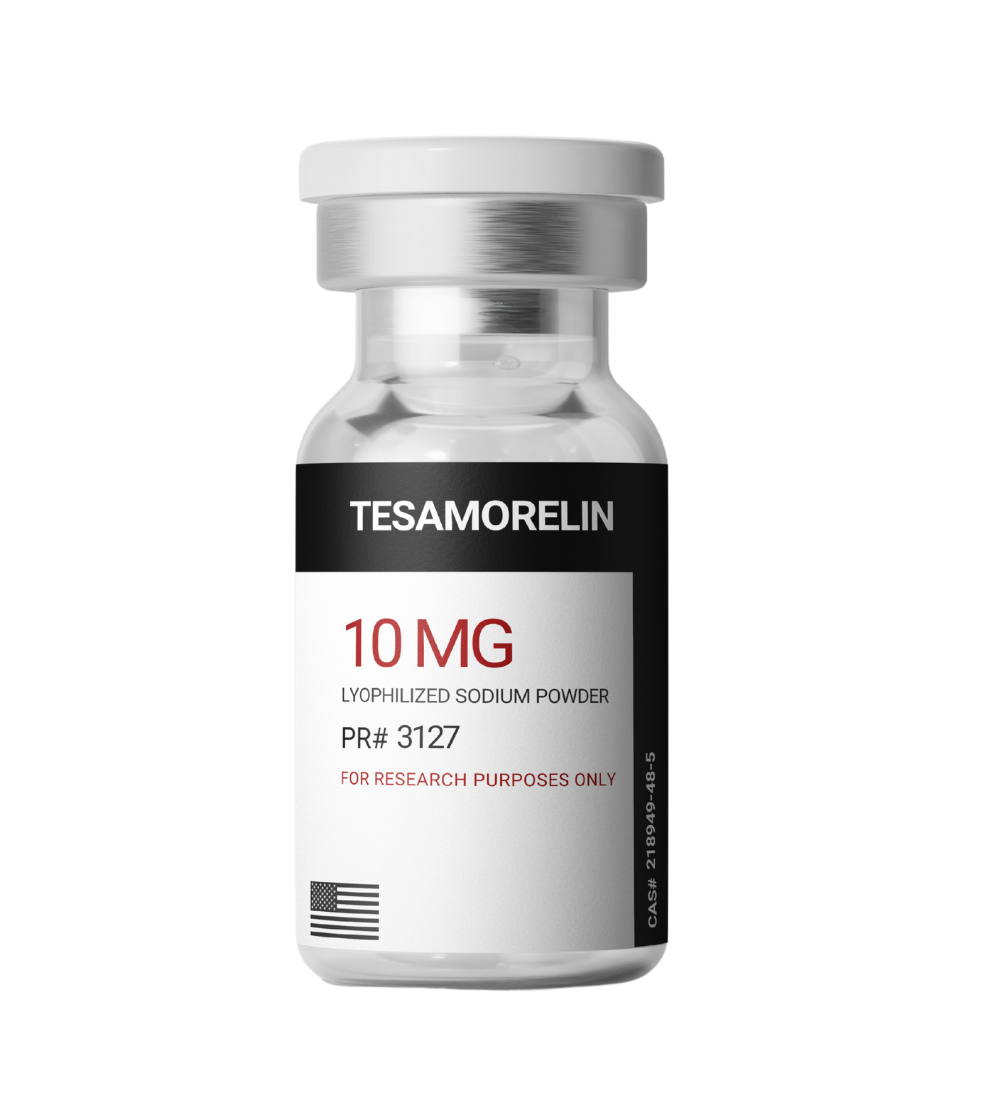
Tesamorelin 10mg
$61.00
Tesamorelin 10mg | Tesamorelin is a GHRH analog researched for lipodystrophy, body composition improvement, and natural GH stimulation.


QR codes
Tesamorelin has been studied for its potential mechanism of action, posited to be similar to growth hormone-releasing hormones (GHRH) receptors located at the anterior pituitary gland, possibly leading to increased production and secretion of growth hormones. Growth hormones may act on several cells, including hepatocytes, stimulating the systemic synthesis of insulin-like growth factor-1 (IGF-1). In addition, growth hormone may also stimulate IGF-1 production locally, inside various tissues.(1) IGF-1 has been posited to be the main anabolic mediator of growth hormone, potentially working to stimulate growth and inhibit programmed cell death.(1) On the other hand, growth hormone itself is suggested to be lipolytic, inducing fat breakdown at specific adipose depots, such as abdominal and visceral fat depositions. Tesamorelin appears to stimulate the release of growth hormone, and consequently IGF-1, by potentially interacting with the GHRH receptors in the anterior pituitary gland cells. When Tesamorelin interacts with the GHRH receptor, it is hypothesized that this interaction might alter the receptor’s structure, potentially initiating communication pathways within the cell. It is also theorized that Tesamorelin might enhance the production of cyclic adenosine monophosphate (cAMP) in certain cells. This process may occur through the stimulation of adenylate cyclase, an enzyme that converts adenosine triphosphate (ATP) into cAMP. Increased cAMP levels may lead to the activation of protein kinase A (PKA), an enzyme deemed critical for transmitting signals within cells. Activated PKA may phosphorylate various target proteins, triggering a cascade of cellular responses. The conjectural stimulation of the GHRH receptor by Tesamorelin and the cAMP-PKA signaling pathway might promote the secretion and distribution of growth hormone (hGH) from somatotroph cells in the pituitary gland. Research indicates that this peptide may lead to an estimated 69% increase in overall growth hormone levels, measured by the area under the curve (AUC), and a reported 55% increase in the mean pulse area of the growth hormone. However, it does not seem to influence the frequency or peak levels of growth hormone pulses. Additionally, IGF-1 levels apparently surged by 122%.(3) The N-terminus and C-terminus of the GHRH molecule are altered in Tesamorelin, potentially lending stability to the peptide and possibly increasing the compound’s resistance to enzyme deactivation compared to natural GHRH.(4) Focusing on the specific alterations, the C-terminus of Tesamorelin is modified by the addition of a trans-3-hexenoic acid group. This particular change, often referred to as an omega-amino acid modification, is believed to potentially reinforce the peptide’s defense against enzymatic breakdown. On the other end, the N-terminus is modified by the attachment of an acetyl group, represented by the chemical notation CH₃CO-. This acetylation might enhance not only the molecule’s stability but also its biological activity. As a result of these specific modifications, Tesamorelin is designated chemically as N-(trans-3-hexenoyl)-[Tyr1]hGRF(1–44)NH2 acetate, highlighting the specific alterations made to the peptide. Molecular Formula: C221H366N72O67S Molecular Weight: 5136 g/mol Other Known Titles: (3E)-hex-3-enoylsomatoliberin
Related products
 Tesamorelin 10mg